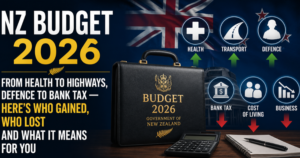
 Auckland (Avneet Kaur) Budget 2026 has officially been unveiled, bringing billions of dollars in spending promises, infrastructure projects, department cuts and new policies as the coalition government attempts to balance economic pressure with election-year expectations.
Finance Minister Nicola Willis says the Government is focused on “careful spending” while trying to return New Zealand’s books back into surplus by 2028/29, one year earlier than previously expected.
Treasury is forecasting the economy will grow by an average of 2.7 percent over the next four years.
But beyond the economic language, the Budget decides where taxpayer money will go, which sectors are receiving support and where savings or cuts are happening.
Health Gets Biggest Share — $5.5 Billion
Health is the biggest winner in Budget 2026, receiving a massive $5.5 billion package.
Most of the funding will go toward maintaining current health services, but there are also several major announcements:
• Bowel cancer screening age will gradually reduce from 58 to 56 starting from September.
• Another 200,000 New Zealanders are expected to become eligible for screening by 2028.
• Government says the change could help prevent hundreds of cancer cases and save more than 500 lives over coming decades.
• Funding has also been provided for the Government’s 72-hour post-natal hospital stay policy for mothers and newborn babies.
• Money has additionally been allocated to secure land for a future South Auckland hospital.
Schools, Trades Academies And Fee Hikes
Education also secured major investment this year.
The Government announced:
• Thousands of new classroom spaces through school expansions and upgrades.
• Around 4700 extra student places nationwide.
• Expansion of Trades Academies with plans for 20,000 more placements by 2030.
However, university students are also facing higher costs:
• Tertiary fees will rise by 6 percent from 2027.
• Savings from scrapping the final year of free university education are being redirected into other education priorities.
Billions For Roads, Rail And Highways
Transport and infrastructure projects dominate large parts of the Budget.
Key announcements include:
• Nearly $1.8 billion for the next stage of the Waikato Expressway between Cambridge and Piarere.
• The route has long been considered one of New Zealand’s more dangerous highway stretches.
• More than $1 billion committed toward KiwiRail upgrades.
• Additional $400 million for strengthening vulnerable state highways, including SH25 in Coromandel and SH2 through Waioweka Gorge.
Defence Spending Surges Past $3 Billion
Defence is another major Budget winner.
The Government announced:
• More than $3 billion for defence force upgrades.
• Funding for military fleet improvements.
• Operational cost increases.
• Salary increases for defence personnel.
The investment comes amid growing international security concerns and geopolitical tensions.
Police And Prisons Receive Major Funding Boost
Law and order spending has also increased sharply.
Corrections will receive:
• $487 million to deal with rising prison populations.
• Additional frontline staffing support.
Police will receive:
• Nearly $400 million over four years.
• Around $50 million specifically aimed at frontline policing services.
Housing Support — But Critics Say It’s Still Not Enough
Housing remains one of New Zealand’s biggest ongoing problems.
The Budget includes:
• Financial incentives for councils linked to new housing developments.
• Funding support for roads, infrastructure and services needed for urban expansion.
• Nearly $70 million toward building around 2250 new social homes starting from 2028.
The Government also confirmed previously announced welfare and housing-related changes involving:
• Social housing tenant obligations.
• Accommodation Supplement adjustments.
• Temporary Additional Support reductions.
SuperGold Card To Become Official ID
One of the more practical announcements for seniors is the upgrading of the SuperGold card.
The new version:
• Will become an official form of identification.
• Include photo ID and additional security features.
• Be available in both digital and physical formats.
New Bank Tax Introduced
One of the Budget’s surprise announcements is a new banking industry levy.
The levy:
• Will help fund Reserve Bank operations.
• Is expected to raise approximately $209 million over four years.
It effectively acts as a new tax on banks.
$450 Million Emergency Fuel Crisis Fund
With global fuel prices remaining unstable, the Government has created:
• A $450 million emergency fuel response buffer.
The fund is designed to help:
• Essential services continue operating during major fuel price spikes or shortages.
• Government agencies manage high fuel-related operational costs.
More Money For Diplomacy And Pacific Relations
Foreign affairs and aid spending also increased significantly.
The Budget includes:
• $145.3 million for New Zealand’s overseas diplomatic network.
• $109.8 million for humanitarian and development support across the Pacific and Indo-Pacific region.
• $20 million for hosting the Pacific Islands Forum in New Zealand in 2027.
Foreign Minister Winston Peters said the world was becoming increasingly unstable, requiring stronger international engagement.
Major Department Savings And Spending Cuts
Despite the large spending announcements, many government departments are also facing major savings targets.
Agencies affected include:
• Kāinga Ora
• Inland Revenue
• MBIE
• Department of Conservation
• Treasury
• Stats NZ
• Ministry of Education (tertiary division)
• Te Puni Kōkiri
• Ministry of Pacific Peoples
• Kāinga Ora alone is expected to save around $368 million over four years.
Meanwhile, the Department of Prime Minister and Cabinet is receiving a $58 million funding increase.
So What Does Budget 2026 Really Mean?
The Government says the Budget is about:
• Economic recovery,
• Controlled spending,
• Infrastructure growth,
• And returning New Zealand’s finances back into surplus.
But many New Zealanders are likely to judge the Budget more simply:
• Will it reduce pressure on families?
• Will it help with the cost of living?
• Will housing become easier?
• Will groceries, rent and fuel become more manageable?
For some, Budget 2026 will look like a long-term investment plan focused on stability and infrastructure.
For others, it may feel like immediate household struggles still remain while billions are directed toward future projects and government systems.
Either way, Budget 2026 is shaping up to be one of the country’s most politically important budgets in recent years as New Zealand moves closer toward election season.